Florida ballot · November 3, 2026
By Kelly Burchill, Broker Associate at Compass and third-generation South Tampa native · Updated Sept. 29, 2026
The short answer
Florida Amendment 3 would raise the homestead exemption on non-school property taxes to $150,000 in 2027 and $250,000 in 2028, and lower the yearly assessment cap on non-homestead property from 10% to 5%. School taxes wouldn't change. It needs 60% of the vote to pass.
Amendment 3 at a glance
Today (2026) | If Amendment 3 passes | |
Homestead exemption, non-school taxes | $51,411 | $150,000 in 2027, $250,000 in 2028, then adjusted for inflation |
Homestead exemption, school taxes | $25,000 | $25,000 (no change) |
Yearly assessment cap, non-homestead | 10% | 5% (non-school taxes) |
New residents (Jan. 1, 2027 or later) | Same as everyone | Current exemption for 4 years, larger one starting year 5 |
Takes effect | Current rules | Jan. 1, 2027 (first bills November 2027) |
Why I looked into this
It started with a phone call from my mom.
She'd been hearing people argue both sides of Amendment 3, so she started doing her own homework. And she started with something we both know well: the house I grew up in, on Dickens Avenue in Sunset Park. Our family owned it for more than 40 years.
It was a one-story, roughly 2,000-square-foot house. The last year we owned it, the property taxes were $3,833.
Today there's a roughly 6,000-square-foot home on that same lot. Its projected 2026 taxes are over $38,000. And that's with the homestead exemption.
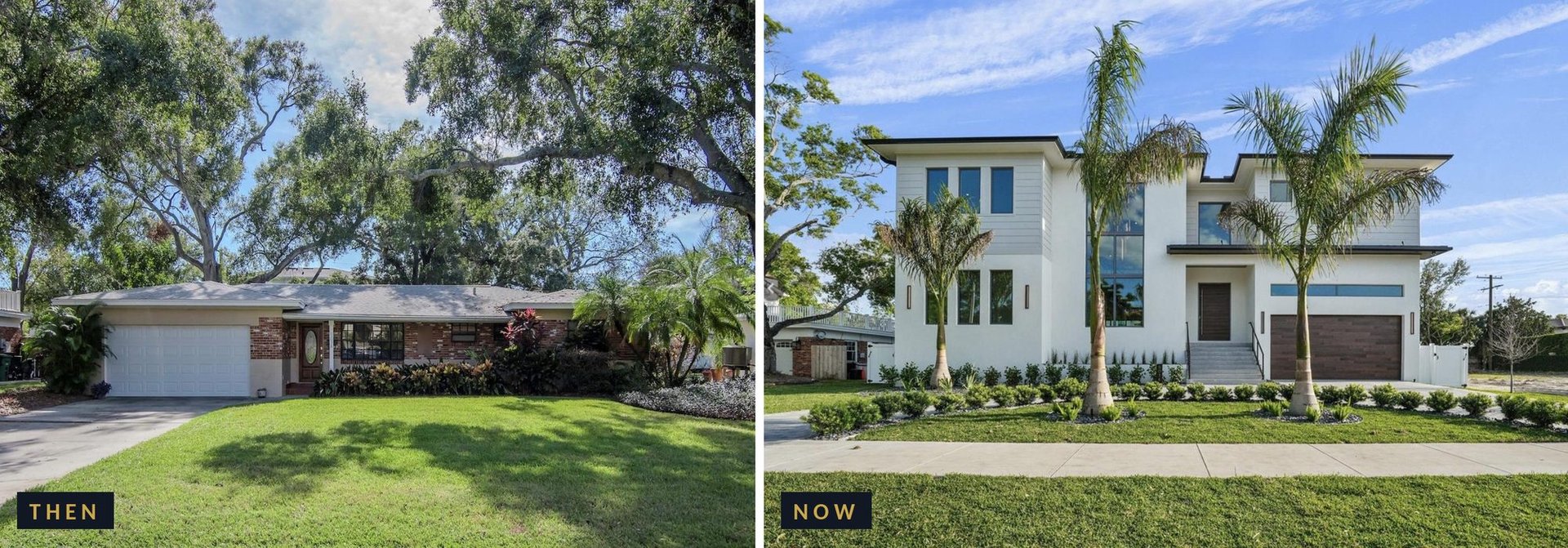
The house I grew up in on Dickens Avenue, and the home on that lot today.
Our house, last year owned
$3,833
2,000 sq ft
Same lot, 2026 projected
$38,000+
6,000 sq ft
Before: 5 original homes on Dickens
$5,693
average yearly property taxes
After: the new builds on those 5 lots
$46,065
average yearly property taxes
709%
The increase in average property taxes on those five Dickens lots. On one street in Sunset Park.
"With numbers like that, where is all that money going?"
It's a fair question. It deserves a real answer, not a slogan.
Part of the answer is how Florida's system works. When a home sells, or gets torn down and rebuilt, the Save Our Homes cap starts over and the new house is taxed on its full market value. So most of that jump comes from the value resetting, not from tax rates going up. The rest of the answer is further down.
I figured if my mom had questions, a lot of other people do too. So I read the amendment, the property appraiser guidance, the state's revenue estimates and the arguments from both sides. Then I put it in plain English.
This isn't a "vote yes" post or a "vote no" post. It's the information I'd want before I walked into the booth.
Full transparency: I'm a Realtor. Florida Realtors, the trade association, supports Amendment 3 and is the main funder of the Yes campaign. I'm not writing this for them, and I'm not telling you how to vote. That part is yours.
I made a printable guide for you.
Everything on this page in a few pages, a sample TRIM notice showing exactly which numbers to use, and a simple worksheet to figure out what Amendment 3 could mean for your own tax bill.
What
What is Florida Amendment 3?
A proposed change to the Florida Constitution that changes how property is taxed. The Legislature put it on the ballot in a June 2026 special session (HJR 1F). It does four things.
$250K
Bigger homestead exemption
On non-school taxes, in two steps: $150,000 in 2027, then $250,000 in 2028.
5%
Lower cap for non-homestead
Second homes, rentals and commercial property: yearly assessment increases capped at 5% instead of 10%.
Year 5
A wait for new residents
People who arrive on or after Jan. 1, 2027 get the larger exemption starting in their fifth year of homestead.
Limits
Rules on local spending
Limits what cities and counties can spend property tax money on, and opens a path to bigger exemptions later.
The official ballot title is "Increased Homestead Exemption; Lower Cap on Increases in Non-Homestead Property Assessments." You might have seen the original title, "Save Our Homes From Excessive Property Taxes." A Leon County judge ruled that title and summary misleading, and the Attorney General rewrote them in August.
Your vote
What does a yes or no vote mean?
Yes
You want the four changes above written into the Florida Constitution.
No
The current rules stay: about $51,000 of homestead exemption on non-school taxes, and a 10% cap on non-homestead property.
Who
Who does Amendment 3 affect?
Pretty much every property owner in Florida. Just not in the same way.
Biggest change
Homestead owners
Your primary residence, including a condo or townhome. You get the bigger exemption on the county, city and other non-school parts of the bill.
Smaller change
Non-homestead owners
Second homes, rentals, vacant land and commercial property. No bigger exemption, but yearly assessment increases for non-school taxes are capped at 5% instead of 10%. School taxes stay based on full market value.
Delayed
New Florida residents
Arrive on or after Jan. 1, 2027 and you start with the current exemption, then move up to the larger one in your fifth year of homestead.
Indirect
Renters
No direct change. Any effect would come through what landlords and local governments do next.
What would stay the same
How much
How much would it save a Tampa homeowner?
For a homestead inside the City of Tampa, the most anyone would save is about $1,300 in 2027 and $2,700 a year starting in 2028. Many longtime owners would save less.
Max savings, 2027
~$1,300
Max savings, 2028 on
~$2,700 / yr
Palma Ceia
The longtime owner
Bought in the late '90s. The home might sell for $1.1 million, but Save Our Homes keeps the assessed value low.
Assessed value | ~$210,000 |
Savings in 2027 | ~$1,300 |
Savings from 2028 | ~$2,100 / yr |
Still pays school tax on | ~$185,000 |
Longtime owners benefit, but savings stop where their assessed value runs out.
Beach Park
The recent buyer
Bought in 2023, so the assessed value is close to what they paid.
Assessed value | ~$950,000 |
Savings in 2027 | ~$1,300 |
Savings from 2028 | ~$2,700 / yr |
School taxes | No change |
That's the ceiling. Same savings whether the house is worth $600,000 or $6 million.
How I got these: Florida tax rates are written in "mills." One mill is $1 of tax for every $1,000 of taxable value. Inside the City of Tampa, the non-school part of the 2025 rate, the only part Amendment 3 touches, is about 13.5 mills. Illustrations only, not tax advice, and they assume rates stay the same.
Not in Tampa?
Estimate your own savings
Two steps, about five minutes. You end up with a rough idea of how much less you would pay each year.
Step 1: Find your non-school tax rate. Pull out your 2026 TRIM notice (the proposed tax notice mailed in August). In Column 5, add up every rate except the two School lines.
In Hillsborough, skip the math and use yours: City of Tampa 13.4 · Temple Terrace 13.2 · Plant City 12.0 · Unincorporated 11.9
Step 2: Multiply that number.
× 99 = what you would save in 2027
× 199 = what you would save each year starting in 2028
Why 99 and 199? Amendment 3 takes about $99,000 more of your home's value off the non-school tax bill in 2027, and about $199,000 more from 2028. Works if your assessed value is $250,000 or more. If it's lower, your savings stop where your assessed value runs out.
Example
Say your non-school rate is 10. Here is roughly how much less you would pay.
You save in 2027
~$990
10 × 99
You save each year from 2028
~$1,990
10 × 199
Page 5 of my printable guide shows a sample TRIM notice with every number you need highlighted, plus a worksheet to fill in. Download it here.
Where it goes
Where does your property tax money go?
In the City of Tampa, your bill splits roughly into thirds. Amendment 3 only touches two of them.
32%
Hillsborough County Public Schools
Not affected
31%
City of Tampa
Affected
31%
Hillsborough County, incl. libraries
Affected
6%
HART, Children's Board, Port Tampa Bay, water district
Affected
Based on 2025 millage for a home inside Tampa city limits. On a $38,000 tax bill like the one on Dickens, roughly a third goes to schools, and that part wouldn't change.
How the City of Tampa sees it
$397M
property taxes, FY2027
$432M
police + fire, FY2027
Property taxes don't even cover public safety on their own. Parks, roads and code enforcement come on top of that.
How supporters see it
6.2076
Tampa city millage, held steady
Rates held steady while rising values pushed collections up. Local governments have grown used to that money and can find savings.
What Amendment 3 would cut
Statewide
~$12B / yr
Less local revenue by 2031-32, per the state's Revenue Estimating Conference. About $4.6 billion in year one.
Hillsborough County
$366.9M / yr
By fiscal 2029, about 23% of its property tax revenue. $248.6 million in fiscal 2028.
City of Tampa
$71-74M / yr
By fiscal 2032. $35 to $40 million in fiscal 2028.
The amendment doesn't include replacement money from the state or guarantee funding for any specific service. It limits property tax spending to a list of categories, including public safety, infrastructure, natural resources and flood projects, debt, retirement obligations and general operations. How local governments would respond (cut spending, raise fees, raise rates, or some mix) is up to them. Nobody can tell you that for sure today.
When
When would it take effect?
Your 2026 tax bill isn't affected either way.
● Nov. 3, 2026
Election Day. Needs 60%.
● Jan. 1, 2027
$150,000 exemption begins, if approved.
○ Aug. 2027
First TRIM notices showing the change.
○ Nov. 2027
First tax bills reflecting it.
● Jan. 1, 2028
Exemption rises to $250,000.
○ 2029 on
Inflation adjustments. A possible path to bigger local exemptions.
Why
The case for it, and the case against it
In each side's own terms.
For
Gov. Ron DeSantis, the Republican Party of Florida, Florida Realtors
Real savings.
Florida Realtors estimates the average homeowner would save about $1,000 in 2027 and about $1,800 in 2028.
Homeowners should share in the growth.
Values and tax collections have climbed fast, and homeowners are carrying too much of it.
Spending discipline.
Local governments can cut waste without touching essential services, and the revenue estimates overstate the impact.
Lower cost of owning a home.
That helps affordability and helps people stay put, especially retirees on fixed incomes.
Predictability.
A 5% cap gives second-home, rental and business owners more certainty.
Against
Florida Sheriffs Association, firefighter groups, Florida League of Cities, many local officials and nonprofits
Service cuts.
Losses on this scale could mean cuts to police, fire, parks, libraries and more.
The cost could shift.
New fees or higher rates could make up the difference, and renters and businesses don't get the exemption.
No guaranteed funding.
The amendment doesn't protect funding for any specific service.
Unequal treatment of newer residents.
Florida's Supreme Court struck down a similar five-year rule in the 1980s. The new language says "to the extent permitted by the U.S. Constitution," but legal challenges are expected.
Borrowing costs.
Moody's, Fitch and S&P say it would put more pressure on local government credit.
On the ground
How could it affect South Tampa real estate?
A couple of things I'm watching, as someone who does this every day.
Carrying costs drop
Lower ongoing costs for homesteaded owners could make owning more attractive, especially at the entry level and for retirees. Some analysts think that could push prices up, not down.
The lock-in effect could get stronger
Longtime owners already have low assessed values thanks to Save Our Homes. A bigger exemption on top of that could make some people even less likely to sell.
Before you vote
A quick checklist
☐ Look up your assessed value on your county property appraiser's website. That number, not market value, decides your savings.
☐ Read the full amendment text. It's HJR 1F on the Florida House website.
☐ Pull up your sample ballot on your county Supervisor of Elections website.
☐ Ask your CPA for a real estimate for your own situation.
Quick answers
Amendment 3 FAQ
Does Amendment 3 eliminate property taxes in Florida?
No. School taxes remain, and non-homestead property is still taxed. It does create a path for bigger exemptions later.
Will my property tax bill definitely go down if it passes?
Not necessarily. Your taxable value would drop, but local governments still set tax rates and fees every year.
Would my 2026 property tax bill change?
No. The first bills affected would arrive in November 2027.
Does Amendment 3 apply to condos?
Yes, if the condo is your homestead. A condo you rent out or use as a second home would fall under the 5% cap instead.
The bottom line
Amendment 3 is a trade-off.
Lower property taxes for homesteaded owners on one side. Less revenue for local governments on the other. How you weigh that depends on your situation and what you value.
My only goal is that you walk in knowing what you're voting on. If you want to look at what it could mean for your property, happy to walk through it with you.
What part of this is still fuzzy?
Talk it through
Kelly Burchill
Broker Associate, Compass · Licensed in Florida and New York
Sources
- Pinellas County Property Appraiser: Amendment 3 FAQ
- Hillsborough County Property Appraiser: Final 2025 Millage Rates
- Florida House: CS/HJR 1F full text
- City of Tampa: FY2027 Recommended Budget
- ABC Action News: Tampa City Council approves FY2027 budget
- Tampa Bay Business & Wealth: Hillsborough projects $367M loss
- ABC Action News: State economists project $11.8B annual impact
- WLRN: Florida Realtors and the Yes on 3 campaign
- CBS12: Rewritten Amendment 3 ballot language
- WPTV: Supporters and sheriffs on Amendment 3
This post is for general information only. It isn't legal or tax advice, and it isn't an endorsement for or against Amendment 3. For your specific situation, talk with your CPA, attorney or county property appraiser.
ABOUT KELLY BURCHILL
Kelly Burchill is a luxury real estate advisor licensed in Florida (Broker Associate, Compass) and New York (Associate Broker). A third-generation South Tampa native who grew up in Sunset Park, and a former TV news reporter, she helps buyers and sellers across South Tampa and connects clients moving between Tampa and New York City. Two Markets. One Strategy.